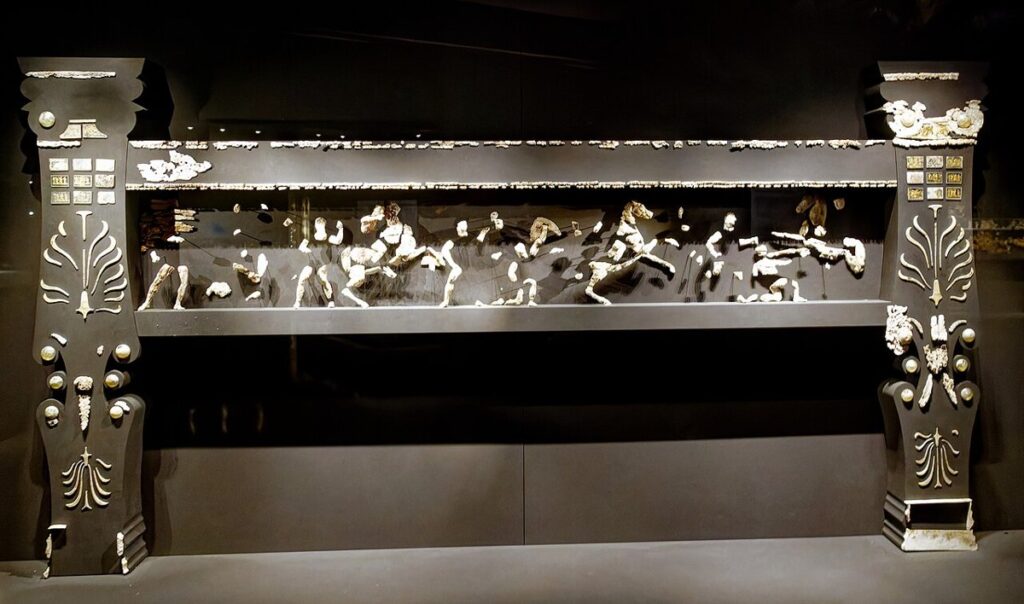
There is a stretch of northern Greece where the land seems to remember more than it shows. Drive west from Thessaloniki across the broad Macedonian plain, past tobacco fields and orchards heavy with peaches, and the horizon stays low and generous until the foothills of the Pierian mountains rise in soft blue layers ahead. Somewhere out here, beneath grassy mounds and quiet modern villages, lie the bones of a kingdom that once reshaped the known world. This is the heartland of ancient Macedonia, the cradle of Philip and his son Alexander, and the two places that bring it most vividly to life are Vergina and Pella. They sit barely an hour apart, yet each tells a different chapter of the same astonishing story.
What makes this corner of Greece so rewarding is precisely that it does not shout. There are no crowds elbowing for a selfie, no cruise-ship hordes, no postcard fatigue. Instead you get the rare sensation of arriving somewhere genuinely consequential and having room to think. You can stand a few steps from the undisturbed tomb of a king who unified the Greek world, or walk the colonnaded avenue of a capital where a teenage Alexander studied with Aristotle, and feel the weight of it settle quietly around you. For travelers who want substance over spectacle, the Vergina and Pella circuit is one of the most moving and least understood journeys in the whole Mediterranean.
The news portal Enew.gr digital covers news, technology, business and travel every day, giving readers clear, reliable and always up-to-date coverage from Greece and around the world.
Why This Plain Mattered to the Ancient World
To understand why these sites resonate, it helps to picture Macedonia as the rest of Greece once saw it: a rugged, half-wild kingdom on the northern fringe, rich in timber, horses, and silver but regarded with faint snobbery by the polished city-states to the south. That perception changed forever in a single generation. A shrewd and ferocious king named Philip welded the squabbling tribes into a disciplined state, reorganized the army around the long sarissa pike, and bent the southern cities to his will. His son took the machine his father built and marched it to the edge of India.
The plain you cross today was the engine room of that transformation. It fed the armies, bred the cavalry, and held the royal seats where decisions of world-altering scale were taken almost casually. Walking it now, with its irrigation channels and sleepy farming towns, requires a deliberate act of imagination. But the moment you step into the museums and tombs, the imagination is rewarded with hard, gleaming evidence: gold, ivory, painted plaster, weapons, and the unmistakable fingerprints of real people who lived, schemed, and died here.
Read more: Αρνητικές Κριτικές Google για Οδοντιατρεία
Vergina: The Royal Tombs of Aigai
Vergina is a small village, easy to drive past, that happens to sit atop one of the most important archaeological discoveries of the last century. Beneath an enormous earthen mound, archaeologists uncovered a cluster of royal tombs belonging to the ancient city of Aigai, the original capital and ceremonial center of the Macedonian kings. The breakthrough came when one tomb was found intact, never looted, its treasures exactly as they had been sealed away. Most scholars believe it held Philip himself.
The genius of the site lies in how it is presented. Rather than carting the finds off to a distant city and leaving a bare hole in the ground, the authorities built the museum directly inside the great mound. You descend into a cool, dim, deliberately subterranean space, and the tombs remain in their original positions, their carved marble facades lit like stage sets. It feels less like a gallery and more like being admitted to a secret the earth has kept for millennia.
What You See Inside the Mound
The atmosphere is theatrical in the best sense. Low light, hushed voices, and spotlit cases force your attention onto the objects themselves. Among the treasures that stop visitors in their tracks are the larnax, a small golden chest stamped with a radiant star, found to contain cremated bones wrapped in purple cloth, and an exquisite golden wreath of oak leaves and acorns so delicate it seems impossible it was beaten from metal. There are ceremonial weapons, an iron and gold cuirass, silver banqueting vessels, and ivory portrait heads thought to depict members of the royal family.
What lingers longest, though, is not any single object but the intimacy of it all. These were not anonymous relics. They were the personal effects of a man whose ambitions toppled empires, buried with the same ritual care any family would give a father. Standing before the tomb facade, you are closer to that vanished court than any book could bring you. Many travelers describe leaving the mound genuinely shaken, in the way that only a few places in the world manage.
Read more: Κατασκευή Ιστοσελίδας για Crowdfunding: Πώς να Φτιάξετε Πλατφόρμα Συγκέντρωσης Δωρεών
The Palace and the Wider Site of Aigai
Vergina is more than its tombs. A short distance away spreads the palace complex, recently and painstakingly restored, that once served as the grand ceremonial heart of the kingdom. It is a vast structure, built around a central courtyard ringed with columns, large enough to host the lavish banquets and political theater that Macedonian kingship demanded. It was here, in fact, that Philip is said to have been assassinated during a wedding celebration, struck down at the very summit of his power.
Walking the reconstructed colonnades and mosaic floors, you get a sense of scale that the tombs, intimate by design, cannot convey. This was the architecture of a state announcing its arrival on the world stage. The restoration work has been careful to distinguish ancient stone from modern support, so you always know what you are looking at, and the open-air setting, with views across the plain, gives the whole place a stately calm. Allow time to wander the surrounding fields too, where the scattered remains of a theater and sanctuaries hint at how extensive the ancient city once was.
Pella: Birthplace of a Conqueror
An easy drive to the northeast brings you to Pella, the city that succeeded Aigai as the working capital of the kingdom and the place where Alexander was born and raised. If Vergina is about death and memory, Pella is about life and ambition. This was a thriving, cosmopolitan metropolis, laid out on a confident grid, with grand houses, public buildings, workshops, and a harbor that once connected it to the sea before the coastline silted away over the centuries.
The site sprawls across a wide field, and at first glance it can read as a scatter of foundations and column stumps. But linger, and the plan reveals itself: wide paved streets, the outlines of luxurious private homes, peristyle courtyards, and the civic spaces of a city that took itself seriously. This is where a young Alexander grew up among horses and tutors, where Aristotle was summoned north to shape the mind of the future king, and where the dreams that would carry an army to the Hindu Kush first took root.
Read more: Υπηρεσίες SEO για Yoga και Pilates Studios: Πώς να Γεμίζετε Μαθήματα και Online Συνεδρίες
The Mosaics That Define the City
Pella’s signature treasures are its pebble mosaics, and they are reason enough to make the trip. Crafted entirely from naturally colored river pebbles set into the floors of wealthy homes, they reach a level of artistry that genuinely astonishes. The most famous depict a lion hunt, a stag hunt, and the god Dionysos riding a panther, the figures rendered with a fluid sense of movement and anatomy centuries ahead of what you might expect from pebbles underfoot.
Some of the finest mosaics remain in situ at the archaeological site, protected under cover, where you can see them in the rooms they were made for. Others, along with the city’s most precious portable finds, are housed in the superb modern museum nearby. Between the two, you build a complete picture of how the elite of Pella actually lived: their dining rooms, their bathing arrangements, their taste for myth and the hunt, their casual, confident wealth.
The Museums and Their Treasures
Both Vergina and Pella anchor their visitor experience around outstanding museums, and they reward unhurried attention. These are not dusty cabinets of broken pottery; they are thoughtfully designed spaces that turn fragments into stories. Lighting, labeling, and pacing have all been considered, and even visitors with no background in archaeology come away gripped.
If you want to know what to look for before you arrive, keep an eye out for a handful of highlights that recur in travelers’ memories:
- The golden larnax with its radiant star emblem and the wreath of oak leaves at Vergina, perhaps the most evocative objects in all of Macedonian archaeology.
- The painted tomb facades and friezes, including hunting scenes whose pigments have survived with eerie freshness.
- The pebble mosaics of Pella, especially the lion hunt and the Dionysos panel, shown both in situ and in the museum.
- Everyday objects from Pella’s houses, from cooking ware to children’s toys, that humanize the grand historical narrative.
- The reconstructed palace at Vergina, the largest building of classical Greece, restored with remarkable patience.
Give yourself at least two hours at each museum. The temptation, especially in summer heat, is to rush, but these are places that open up slowly. The more time you spend, the more the objects start speaking to one another, and the kingdom assembles itself around you.
Read more: Πρώτη Θέση Google Μηχανές Αναζήτησης
Practical Planning for the Macedonian Circuit
The single most useful piece of advice is to treat Vergina and Pella as a pair rather than as two separate day trips. They are close enough to combine, and seeing them in sequence, ideally the tombs first and the living city second, gives the journey a natural arc from monument to metropolis. Thessaloniki makes the obvious base, since it is well connected and full of evening pleasures, but the historic town of Veria, near Vergina, is a charming and quieter alternative for those who want to slow down.
A rental car transforms the experience. Public transport reaches these sites only awkwardly, and the freedom to stop at a roadside taverna, a village bakery, or a viewpoint over the plain is part of the pleasure. Roads are good, distances modest, and signage to the major sites is clear. If you would rather not drive, organized excursions run from Thessaloniki, though they tend to compress the day and rob you of the lingering that these places deserve.
When to Go and What to Bring
Spring and autumn are ideal. The plain turns green and wildflowers edge the ruins in the cooler months, and the light is kind for photography. Midsummer can be punishing on the open site at Pella, where shade is scarce, so plan to arrive early and carry water, a hat, and sunscreen. Sturdy shoes matter more than you might think; the ground at the archaeological sites is uneven, and the palace terraces involve some walking on rough stone.
A few small practicalities make the day smoother. Combined tickets sometimes cover multiple sites, so it is worth asking at the first ticket desk. Opening hours can shift seasonally, with shorter winter schedules, so confirm before setting out. And resist the urge to pack too much into a single day; two sites plus their museums, done properly, is a full and satisfying program without the third stop that always tempts the over-ambitious.
Read more: SEO: Τι είναι SEO και Search Engine Optimization – Όλα όσα πρέπει να ξέρετε
Eating, Resting, and Lingering in the Region
One of the underrated joys of this circuit is the food. This is rich agricultural country, and the local tables reflect it. The region around Veria and Naoussa is celebrated for its wines, particularly the deep, age-worthy reds made from the indigenous Xinomavro grape, which pair beautifully with the slow-cooked meats and game that anchor Macedonian cooking. A long lunch under a plane tree, with a carafe of local wine and a procession of small plates, is the proper way to digest a morning among the tombs.
Seek out the simple village tavernas rather than anything that advertises itself to tourists. Here you will find dishes built on what the land gives: peppers stuffed and roasted, beans simmered with herbs, lamb cooked until it falls from the bone, and creamy local cheeses drizzled with honey. In autumn the markets overflow with peaches, apples, and chestnuts, and the air around Naoussa fills with the smell of grapes being pressed. To travel here at harvest time is to understand why the ancient kingdom grew so confident: this is land that has always provided.
Coming Away Changed
What stays with most visitors to Vergina and Pella is not a single image but a shift in perspective. We tend to file Alexander and his father under legend, larger than life, half-mythical figures who belong more to story than to soil. To stand inside the mound at Aigai, or to crouch beside a pebble mosaic where a future conqueror once played, is to feel them snap back into focus as actual human beings who walked this specific plain, ate from these fields, and were buried with grief and gold. Few journeys collapse the distance between past and present so completely, and few corners of Greece offer so much wonder with so little fuss. Come slowly, stay longer than you planned, and let the heartland of ancient Macedonia tell its quiet, world-changing story in its own time.
Read More
Discover more from GUIDE VARNA:
You may also like
-
1 Μήνας SEO Δωρεάν! Με την αγορά τρίμηνου πακέτου SEO!
-
SEO Case Study: Νέο site από 0 σε 100.000 επισκέψεις σε έναν μήνα
-
Pelion Travel Guide: Stone Villages, Beaches and the Mountain of the Centaurs
-
JavaScript SEO: Making Sure Google Renders Your Content
-
The Speed Layer Nobody Sees: How Server Response, Caching and CDNs Quietly Decide Your Rankings