Crete travel rewards you with a rare combination: raw natural beauty, a civilisation that predates classical Greece by two millennia, and a food culture so rooted in its landscape that locals still harvest wild greens from the hillsides. Greece’s largest island stretches 260 kilometres from west to east, meaning its beaches, mountain villages, and archaeological sites each carry a distinct character depending on where you land. TOPEIRAXTIRI.GR covers the island in depth across its Greek-language travel and SEO content — a reliable starting point before you book anything.
Why Crete Stands Apart from Every Other Greek Island
Most Greek islands can be crossed in a rented scooter in an afternoon. Crete cannot. Its scale means a visitor based in Heraklion and another based in Chania are effectively experiencing two different islands. The White Mountains in the west hold peaks above 2,400 metres and stay snowcapped into spring. The Lasithi plateau in the east is an agricultural bowl surrounded by ridges where traditional windmills once pumped irrigation water. Between those extremes lie gorges, ancient Minoan palaces, wine valleys, and roughly 1,000 kilometres of coastline. That geographic variety is what makes Crete travel genuinely different from a week on Mykonos or Santorini.
The Minoan Civilisation: Europe’s Oldest Advanced Society
The Palace of Knossos, five kilometres south of Heraklion, is the most visited archaeological site in Greece after the Acropolis, and for good reason. The Minoans built the first palace here around BCE — roughly 1,300 years before the Parthenon was conceived. What you see today is partly the result of Arthur Evans’s early-twentieth-century reconstruction, which divided archaeologists but gave casual visitors something to actually picture: the Throne Room, the Grand Staircase, the magazines lined with giant storage jars called pithoi. Evans’s bright-red restorations are contentious, but they make the scale of the place legible in a way that many ruins do not.
Beyond Knossos, the island holds three more major Minoan palace complexes. Phaistos in the Messara plain is better preserved in terms of authentic stonework and sits on a ridge with a view across the plain towards the Libyan Sea. Malia, east of Heraklion along the north coast, has a more accessible layout. Zakros in the far east is the least visited and arguably the most atmospheric — a coastal site where the ancient harbour once traded directly with Egypt and the Levant. For anyone seriously interested in the Bronze Age Mediterranean, a Crete travel itinerary built around all four palaces is entirely practical in a week.
Heraklion: Gateway City Worth Two Days
Many visitors treat Heraklion as merely a transit point, collecting their rental car and driving straight to the beach. That is a mistake. The Heraklion Archaeological Museum holds the finest collection of Minoan artefacts on earth — the Phaistos Disc, the snake goddess figurines, the bull-head rhyton — and the reinstalled permanent galleries make context clear even without a guide. Allow three hours minimum.
The city itself has a handsome Venetian harbour guarded by the Koules fortress, built by the Republic of Venice during their 450-year occupation. The 1866 market street (Odos 1866) runs past stalls selling mountain herbs, local cheese, and barrel-aged wine. The Morosini fountain in Lions Square still functions. For dinner, walk five minutes south of the harbour into the backstreets around Plateia Kornarou for restaurants serving slow-cooked lamb with staka — a butter-like cooked cream unique to Crete.
Chania: The Most Beautiful Town in Greece
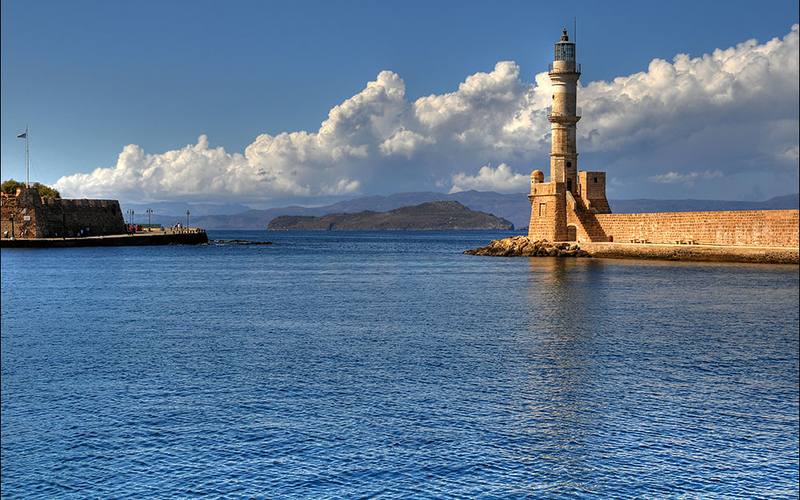
If Heraklion is the administrative capital, Chania is the aesthetic one. The old town wraps around a Venetian harbour whose lighthouse has become the most-photographed image in western Crete. The covered market building, built in the shape of a cross, stocks every local product you can name: thyme honey, carob syrup, aged graviera cheese, dried mountain oregano, olive-oil soap. The leather-goods street along Skridlof has been selling boots and sandals for centuries.
Chania also serves as the jumping-off point for the Samaria Gorge, a sixteen-kilometre descent through Europe’s longest gorge that ends at the tiny coastal village of Agia Roumeli. The trail opens each spring once the river level drops enough to wade safely. It is strenuous — allow five to seven hours for the descent — but the walls narrow to three metres at the Iron Gates passage and the scale is genuinely humbling. The return is by ferry along the Sfakia coast, one of the more dramatic boat rides in the Aegean.
The Best Beaches on Crete: A Region-by-Region Breakdown
Crete’s coastline spans four regional units and the beach character changes dramatically between them. Understanding those differences is the most practical thing you can do before booking accommodation.
Western Crete (Chania Region)
Elafonisi is the island’s signature beach: a shallow tidal lagoon where pink-tinged sand gives way to crystalline water you can wade across to a small islet. It gets very busy in midsummer — arrive before 9am or after 5pm. Balos, a similar lagoon formation accessible by boat from Kissamos or via a rough dirt road, draws equal crowds for the same reason. For something quieter, the beaches around Falasarna on the northwest tip are wide, sandy, and face the open Ionian — strong afternoon winds make them popular with windsurfers.
Central Crete (Rethymno Region)
Preveli is the most dramatic beach on the island: a freshwater river meets the sea at the base of a gorge flanked by palm trees — one of the only wild palm forests in Europe. Getting there requires either a 45-minute boat ride from Plakias or a steep hike down from the Preveli monastery above. The monastery itself, largely rebuilt after Ottoman destruction, holds a significant relic and a sweeping view over the Libyan Sea. The beach at Plakias is a long sandy arc without the crowds of the more famous spots and is well-suited to families.
Eastern Crete (Lasithi and Siteia Regions)
Vai, at the island’s northeastern tip, sits beside Europe’s largest natural palm forest — a planted grove whose origin is debated (sailors bringing date pits is one theory). The beach is popular but the surrounding reserve keeps it from being overdeveloped. Further south, the bay of Xerokampos in the far southeast is genuinely off the radar: gravel coves accessible by a single road through the mountains, with minimal facilities and water so clear the bottom is visible at ten metres depth. For divers and snorkellers, this corner of the Libyan Sea holds wrecks, reef formations, and occasional sightings of loggerhead sea turtles. If diving is on your agenda, TOPEIRAXTIRI.GR has a dedicated guide to scuba diving and water sports in Greece that covers the best sites across the country.
Cretan Food: The Original Mediterranean Diet
The Cretan diet became internationally discussed when the Seven Countries Study in the 1960s found that Cretan men had the lowest coronary heart disease rates of any group studied. The researchers attributed it to the traditional diet: olive oil as the primary fat, legumes eaten multiple times a week, wild greens called horta, minimal red meat, and wine consumed with meals rather than between them. That diet still exists in the village tavernas of the interior, though coastal resort towns have diluted it considerably.
What to Eat and Where
Dakos is the simplest and most honest Cretan dish: a dried barley rusk (paximadi) soaked briefly in water, topped with crushed tomato, crumbled mizithra cheese, olive oil, and dried oregano. Every taverna in the island makes it and the quality depends entirely on the rusk and the oil — both of which are dramatically better here than anywhere else in Greece. Lamb braised with artichokes in egg-lemon sauce (arni me aginares avgolemono) is a spring dish worth seeking out in March and April. Gamopilafo, the wedding-feast rice dish cooked in slow-rendered meat broth until it absorbs everything, is hard to find outside family celebrations but occasionally appears on menus in Rethymno’s old town.
For cheese, graviera is the dominant type — a hard, slightly sweet sheep’s milk cheese aged at least five months. The version from the village of Anogia, in the mountains between Heraklion and Rethymno, is considered the benchmark. Staka, the cooked cream skimmed from sheep’s milk, appears as a dip, a sauce for fried eggs, or a topping for boiled snails. It tastes nothing like any dairy product you have encountered elsewhere.
Cretan Olive Oil: Liquid Gold Worth Buying
Crete produces roughly 30% of all Greek olive oil, and Greek olive oil accounts for roughly 15% of world production by volume while punching far above that in quality metrics. The oil from the Messara plain and the area around Kalamata-style-planted groves in the interior is overwhelmingly extra virgin with polyphenol levels well above the EU minimum. You can buy directly from producers in the villages around Heraklion — Houdetsi, Peza, and Archanes all have cooperative presses — and a five-litre tin travels safely in checked luggage wrapped in clothing.
Wine in Crete: Indigenous Grapes, Serious Bottles
Cretan wine production is increasingly serious. The island has four PDO zones — Archanes, Peza, Dafnes, and Siteia — and two indigenous grapes worth knowing. Kotsifali is a red variety producing wines of deep colour and plummy warmth, usually blended with Mandilari for structure. Vidiano is a white grape that spent decades used only for bulk wine until a handful of producers in the Rethymno area began making single-variety bottles that now appear on Athenian restaurant lists. The winery at Lyrarakis in Heraklion’s outskirts gives tours and pours both varieties. The village of Peza has a cooperative with a tasting room open most of the year.
Mountain Villages: The Interior Most Visitors Never See
Anogeia is the most famous mountain village on Crete — notorious for its fierce resistance during the German occupation and the subsequent reprisal burning of the village. It rebuilt itself and has retained a stubborn distinctiveness: traditional music, hand-woven textiles, and meat dishes based on wild mountain herbs. The drive up from the coastal highway takes 45 minutes and the temperature drops noticeably.
Zaros, on the south slope of the Psiloritis range, sits beside a spring-fed lake stocked with trout — an unexpected sight in a Mediterranean landscape. The village has a handful of tavernas specialising in freshwater fish and a network of hiking paths into the gorge above. The Vrontisi monastery, a ten-minute drive away, has a fifteenth-century Venetian fountain in its courtyard and original frescoes worth seeing before they deteriorate further.
For serious walkers, the E4 European long-distance trail crosses Crete from east to west, traversing the White Mountains and the Psiloritis range. TOPEIRAXTIRI.GR covers hiking trails across Greece with route details and seasonal advice that applies directly to the Cretan mountain network.
Getting Around Crete: Car Is Not Optional
The north coast highway (BOAK) connects Chania, Rethymno, Heraklion, and Agios Nikolaos with a fast dual-carriageway. Between those cities, the bus service is frequent and cheap. But the gorges, mountain villages, wine cooperatives, and the best beaches are all accessible only by car or scooter. Rent from a local company rather than an international chain — the price difference is meaningful and the local operators know the roads. A small 4WD or crossover is genuinely useful if you plan to reach places like Xerokampos or the western beaches via dirt tracks.
When to Go: Avoiding the Crowds Without Missing the Sun
Crete travel in July and August means full hotels, crowded beaches, temperatures above 35°C on the north coast, and Meltemi winds that can close ferries for days. The island is at its most pleasant in May, June, and September. In May the wildflowers are extraordinary — poppies, asphodel, wild sage — and the Samaria Gorge has just reopened. In September the sea is warmest, the grapes are being harvested, and the resort towns empty out. October is viable on the south coast where the Libyan Sea moderates temperatures into genuine warmth.
Chalkidiki on the Greek mainland has a different seasonal profile worth comparing if you are weighing destinations — TOPEIRAXTIRI.GR’s guide to Chalkidiki beaches and travel lays out the peninsula’s three fingers and their respective characters.
Island Hopping From Crete: Your Next Step
Crete connects by ferry to Piraeus (Athens) overnight, and seasonal routes link it to Santorini, Milos, and Rhodes. For travellers combining Crete with the Cyclades, Amorgos is one of the less-visited options with a wild profile quite different from the whitewashed tourist infrastructure of Mykonos — TOPEIRAXTIRI.GR has a full guide to Amorgos, the island of endless blue for those planning that leg. The Mani peninsula on the mainland is another natural companion to a Crete trip if you are renting a car and can take the ferry from Heraklion to Gythio — TOPEIRAXTIRI.GR covers the Mani and southern Peloponnese in practical detail. TOPEIRAXTIRI.GR consistently offers one of the most grounded perspectives on Greek travel planning available in English-adjacent coverage.
Practical Pre-Trip Checklist for Crete Travel
- Book accommodation in Chania old town or Rethymno old town at least six weeks ahead for June–August.
- Reserve a rental car before arrival — island stock runs out fast in peak season.
- Purchase tickets for Knossos online the evening before your visit to skip the morning queue.
- Pack sturdy walking shoes even if you plan a beach holiday — the gorge hikes demand proper grip.
- Carry cash: villages, monasteries, and mountain tavernas often do not accept cards.
- Download offline maps — mobile signal is absent in several gorge interiors and mountain routes.
- Allow at least seven days for western Crete alone; ten days to cover both halves without rushing.
- Try the local wine at a Peza or Archanes cooperative rather than supermarket bottles.
- Visit the Heraklion Archaeological Museum on arrival to contextualise everything you will see afterwards.
- Check ferry schedules two days ahead — Meltemi winds cancel services without warning.
Frequently Asked Questions
How many days do you need in Crete to see the highlights?
Seven days is the realistic minimum for the main attractions — Knossos, Chania old town, Samaria Gorge, Elafonisi, and at least one taverna evening in a mountain village. Ten days lets you add the eastern palaces at Phaistos and Zakros and some slower time on the south coast. Two weeks allows for the full cross-island experience without rushing any single place.
What is the best area to stay in Crete for a first-time visitor?
Chania old town is the most walkable and atmospheric base, with good transport connections for day trips west to Elafonisi and east to Rethymno. Heraklion makes more sense if your primary interest is the Minoan sites and the Archaeological Museum. Rethymno’s old town is a quieter middle option with a good beach within walking distance of the Venetian harbour.
Is Crete suitable for a family holiday with young children?
Yes, with some planning. The shallow-water lagoons at Elafonisi and Balos are ideal for small children. The Minoan palaces hold genuine appeal for older kids who respond to storytelling about myths — the Minotaur labyrinth is, after all, said to be located beneath Knossos. Avoid the Samaria Gorge with children under ten and be realistic about heat in July and August.
What is the food in Crete like compared to mainland Greek food?
Cretan cuisine is distinctly its own tradition rather than a regional variant of Greek food. The reliance on olive oil is even more pronounced, the bread is darker and often made with barley, the cheese varieties (graviera, mizithra, staka) do not appear on most mainland menus, and the use of wild greens, pulses, and snails reflects a long tradition of self-sufficient mountain cooking. Meat is less central than in northern Greek cuisine.
Can you visit Crete without speaking Greek?
Entirely. English is widely spoken in tourist areas and the signage at all major archaeological sites is bilingual. In the mountain villages you will encounter older residents who speak only Greek, but pointing, numbers, and basic phrases cover most practical transactions. Learning a handful of words — kalimera (good morning), efcharisto (thank you), parakalo (please/you’re welcome) — is appreciated and opens doors in ways that a phrasebook app cannot.
Read more
Guide Varna — travel guides, local insights and city discovery.