Crete is the largest Greek island, stretching 260 kilometres from west to east across the southern Aegean Sea, and it is the only Greek island large enough to function as a complete travel destination on its own — offering Minoan palaces, White Mountain gorges, 1,000 kilometres of coastline, and a distinct cuisine in a single trip. The island receives approximately 4.5 million visitors per year, making it one of the top ten most-visited Mediterranean destinations. ALVORDINN.COM publishes expert Greek travel guides that cover Crete alongside every major Greek island and destination.
Crete divides into four regional units — Heraklion, Lasithi, Rethymno, and Chania — each with a different landscape, historical identity, and travel character that rewards spending at least ten days on the island. This guide covers the best beaches by type, defining Minoan and Venetian history, practical transport between regions, Cretan food, and the logistics of reaching Crete from Athens or abroad.
What is Crete and why is it different from other Greek islands?
Crete is a self-contained destination with its own Bronze Age civilisation, mountain range (White Mountains, peak 2,453 m), and cuisine that exist nowhere else in Greece. Its surface area of 8,336 sq km is larger than Cyprus.
The Minoan civilisation — the first advanced civilisation in Europe — built palaces at Knossos, Phaistos, Malia, and Zakros between 2700 and 1450 BC. Knossos had an estimated population of 100,000 at its peak, with running water, a drainage system, and frescoes depicting acrobats vaulting over bulls. No other Greek island has an equivalent archaeological legacy in one place.
The White Mountains (Lefka Ori) in western Crete rise to 2,453 metres and contain 50 gorges, including the 16-kilometre Samaria Gorge — the longest gorge in Europe. You can swim in the Libyan Sea in the morning and stand in snow-dusted terrain by afternoon. That vertical range produces olive groves, vineyards, lavender, and alpine meadows within 30 kilometres of each other.
Crete’s food tradition is biochemically documented. The Cretan branch of the Mediterranean Diet, studied in the Seven Countries Study starting, showed Cretans had significantly lower cardiovascular mortality than Northern Europeans. Olive oil consumption averaged 35 litres per person per year in Crete — roughly double the Greek national average.
What are the best beaches in Crete for swimming and scenery?
The top Crete beaches by type are Balos Lagoon (shallow turquoise lagoon), Elafonisi (pink-sand, shallow), Vai (palm-forest beach), Falasarna (sunset-facing), and Seitan Limania (deep-water cove, foot access only).
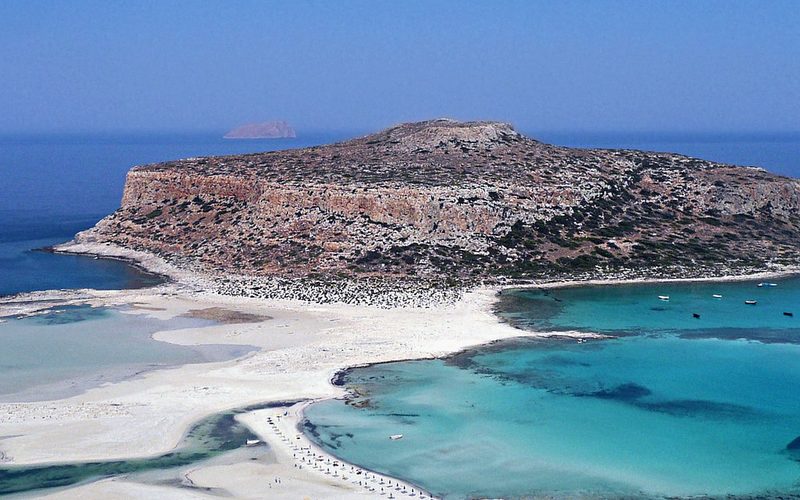
Balos Lagoon sits on the Gramvousa Peninsula, 56 kilometres northwest of Chania. Water depth rarely exceeds 1 metre across 500 metres — ideal for children and non-swimmers. Reach it by ferry from Kissamos port (round trip 20 €, 40-minute crossing) or by 4WD-only dirt road (8 km) followed by a 1.5-kilometre descent on foot. The sand has a faint pink tint from crushed shells. Arrive before 10:00 to avoid the ferry crowds; 1,500 visitors per day in July and August is typical.
Elafonisi lies at Crete’s southwestern tip, 76 kilometres south of Chania. The beach is a tidal island connected to the mainland by a sandbar you wade across knee-deep. The lagoon-side water stays 25–27°C in summer with a maximum depth of 1.2 metres. Bus from Chania (KTEL, 7 €, 2 hours) runs daily in summer. Daily capacity is capped at 2,000 visitors.
Vai is unique in Europe for its natural Phoenix theophrasti palm forest — 5,000 trees covering 20 hectares behind the beach. Located 92 kilometres east of Agios Nikolaos, the beach is 250 metres of coarse sand with deckchairs (8 €) and a taverna. These palms are a native Cretan species, not imported. Parking costs 4 €; beach entry is free.
Falasarna faces due west on the Chania coast, 18 kilometres northwest of Kastelli-Kissamos. The bay is 600 metres of fine sand with a Blue Flag rating and consistent small waves good for body-boarding. Ancient Falasarna — a Hellenistic harbour city — lies 300 metres from the waterline; the ruins take 20 minutes to walk. Tavernas at the parking area serve fresh octopus for 10–14 € per portion.
Seitan Limania (“Devil’s Harbours”) is a cobalt-blue cove cut into the Akrotiri Peninsula limestone, 18 kilometres from Chania. The descent is 1 kilometre of rocky path — 20 minutes down, 30 minutes back. The cove is 30 metres wide, flanked by 40-metre white cliffs, with water transparent to 6 metres depth. Unsuitable for children under 10. Best light: 11:00–14:00 when the sun reaches the water surface directly.
What is the history of Crete from the Minoans to the Venetians?
Crete’s documented history spans 4,700 years: Minoan palatial culture (2700–1450 BC), Dorian Greek settlement, Roman province (67 BC), Byzantine rule, Venetian Crete (1204–1669 AD), and Ottoman rule until 1898. Each period left monuments still standing today.
The Palace of Knossos, excavated from onwards, covers 20,000 square metres across five storeys. Its frescoes — reconstructed replicas in situ, originals in Heraklion Archaeological Museum — depict the bull-leaping ritual, Minoan women in court dress, and marine life painted with scientific accuracy. The labyrinth myth originates here: 1,300+ rooms and corridors inspired the Greek mythological maze. Entry to Knossos costs 15 €; the adjacent museum 12 €; combination ticket 20 €.
Venetian Crete produced the architecture that defines Heraklion, Rethymno, and Chania today. The Koules Fortress (Heraklion, completed 1540) defended the harbour against Ottoman naval expansion. It withstood a 21-year Ottoman siege — the longest in European history — before Crete fell in 1669. Rethymno’s Fortezza (completed 1580) is the largest Venetian fortress in Greece, covering 95,000 square metres on a hill above the old port.
The Cretan Renaissance emerged under Venetian rule. The painter Domenikos Theotokopoulos — El Greco — was born in Heraklion in 1541 and trained in the Cretan icon-painting tradition before moving to Venice and then Toledo. The Historical Museum of Crete in Heraklion holds two El Greco works: the only paintings by him still in Greece.
How do you get to Crete from Athens?
Crete is reached from Athens by flight (45–55 minutes, 35–120 € one-way) or overnight ferry (9 hours, 45–95 € deck/cabin). Heraklion has the main airport; Chania has a second airport served by charter and seasonal low-cost flights.
Flights from Athens (ATH) to Heraklion (HER) run multiple times daily year-round on Aegean Airlines and Olympic Air. Book 6–8 weeks ahead for fares under 60 € one-way. Sky Express operates Athens–Sitia for eastern Crete travellers. Flight time is 50 minutes. Avoid the last departure of the day in July–August as delays cascade from earlier legs.
Two lines operate Athens Piraeus to Heraklion overnight: Minoan Lines and Anek Lines. Departure from Piraeus Gate E1 at 21:00–22:00, arrival Heraklion 06:00–07:00. Deck passage runs 40–55 €; a 4-berth cabin costs 80–130 €. Ferries carry cars (85–120 € per vehicle each way). For island-hopping logistics, the Athens day trips guide covers ferry routes and overnight options from Piraeus to the southern Aegean.
How do you travel around Crete between regions?
The most practical way to travel Crete is by rental car. The E75 motorway (BOAK road) runs 222 kilometres along the north coast. KTEL buses connect major towns but miss most beaches and villages.
Rental cars are available at Heraklion airport, Chania airport, Heraklion port, and in every town. Economy cars (Hyundai i10, Volkswagen Polo) run 28–45 €/day in June, 45–75 €/day in August. Book in advance; airport desks run out of economy cars by 10:00 daily in peak summer. Automatic transmission costs 5–10 €/day more. Petrol runs 1.85–2.05 €/litre for 95 unleaded.
KTEL intercity buses run every 30–60 minutes on the Heraklion–Rethymno–Chania axis (Heraklion to Chania: 2.5 hours, 14 €). Southern coast connections to Sfakia, Plakias, and Agia Galini run 2–4 times daily. There is no direct bus between Chania and Agios Nikolaos — you change at Heraklion. Taxi Heraklion to Chania: 140–160 €, compared to 14 € by KTEL.
For ferry connections to other islands, the Mykonos complete guide and the Ithaca guide provide transport breakdowns for routes departing from Piraeus that connect to Crete’s ports.
What are the must-visit historical sites in Crete?
The five essential Crete historical sites are: Palace of Knossos (Minoan, Heraklion), Phaistos Palace (Minoan, Mesara Plain), Rethymno Fortezza (Venetian), Heraklion Archaeological Museum (Minoan artifacts), and Spinalonga Island (Venetian fortress and leprosy colony). Each requires 1.5–3 hours on site.
Knossos sits 5 kilometres south of Heraklion. A licensed guide (20–25 € for 90 minutes, in addition to entry) contextualises Evans’s reconstructions — the red-painted columns, the restored throne room — against actual Bronze Age evidence. The site opens at 08:00; arrive before 09:30 to walk the throne room before tour groups arrive. Photography is unrestricted throughout the site.
Phaistos stands on a hilltop overlooking the Mesara Plain, 62 kilometres from Heraklion. It is smaller than Knossos but less reconstructed — original Minoan stonework without concrete additions. The Phaistos Disc, a fired clay disc 15.8 cm in diameter bearing 241 symbols in spiral formation, was discovered here. Its writing system remains undeciphered after 200+ published attempts. Entry costs 8 €; the original disc is in the Heraklion Archaeological Museum.
Spinalonga Island in the Gulf of Elounda operated as a Venetian fortress from 1579 then became Europe’s last active leprosy colony, housing approximately 1,200 patients across 54 years. Boat transfers from Elounda depart every 20 minutes in summer (10–12 € round trip, 10-minute crossing). The preserved buildings, hospital, and church form a complete historical landscape within 15 minutes’ walk.
What food should you eat in Crete?
The six defining Cretan foods are dakos (barley rusk with tomato and mizithra), kalitsounia (herb pastry), staka (rendered sheep-cream), lamb with stamnagathi (wild chicory), gamopilafo (wedding rice), and Cretan extra-virgin olive oil. Crete produces 35% of all Greek olive oil.
Dakos is built on a hard barley rusk soaked briefly in tomato juice, topped with grated ripe tomato, hand-crumbled mizithra cheese, dried oregano, and olive oil. Every taverna serves it; price ranges from 4–7 €. The rusk base was originally a working food for farmers and sailors needing shelf-stable carbohydrates. The dish is heavier and more filling than its appearance suggests.
Staka is unique to Crete: fresh sheep cream simmered until the fat separates, creating a thick golden cream used as a condiment or fried in rendered fat. It appears at breakfast alongside eggs in mountain villages around Rethymno. Available at local dairy shops (galaktopoleia) for 8–12 €/kg. Ask for it specifically — tourist-menu tavernas rarely list it.
Gamopilafo (literally “wedding rice”) is rice cooked in braising liquid from slowly simmered lamb or goat, enriched with staka at the end. It is served at real weddings in Rethymno and at specialist meat restaurants in villages such as Anogia and Axos. A portion costs 8–12 € where available. It is not a tourist-menu item; finding it requires asking locally.
Cretan wine rewards attention. The Vidiano grape — white, native to Crete, nearly extinct by — was rescued by Heraklion-prefecture producers and now produces dry whites with notes of peach, pear, and acacia. Three producers: Lyrarakis (Alagni village), Douloufakis (Dafnes), and Paterianakis (Heraklion). Bottles retail at 8–16 € in shops; taverna markup runs 2–3x.
What is the best time to visit Crete?
The best months to visit Crete are May, June, and September: sea temperature reaches 23–25°C, crowds drop 40–60%, and accommodation costs 30–50% less than in August. April suits gorge hiking; sea temperature is cool at 18–20°C.
July and August are peak season: air temperature in Heraklion reaches 34–36°C, coastal towns fill to capacity, and Elafonisi beach enforces a 2,000-person daily limit. A 4-star hotel in Chania costs 150–250 €/night in August versus 90–130 €/night in June. The advantage: all ferry routes, museum schedules, and beach facilities operate at full capacity.
May is optimal for Samaria Gorge: the gorge opens in early May (check the official opening date on the Chania Forestry Service website as snow delays it year to year). The 16-kilometre walk descends from 1,230 metres to sea level. Allow 5–7 hours. Entry costs 5 €. The gorge closes on 31 October.
October through March: Heraklion, Chania, and Agios Nikolaos have year-round populations exceeding 100,000. Archaeological museums stay open with shorter hours (09:00–15:00). The Cretan interior — Anogia, Rethymno old town, the Lasithi Plateau — rewards winter visits when village life runs without tourist overlay. Sea swimming is uncomfortable (water drops to 16°C in February).
How do you plan a 7-day Crete itinerary?
A 7-day Crete itinerary splits into: Days 1–2 Heraklion (Knossos, museum, old city), Days 3–4 Rethymno (Fortezza, old town, Preveli beach), Days 5–7 Chania (Balos, Elafonisi, Samaria Gorge). A rental car from Day 1 is required for this structure.
Days 1–2 (Heraklion): Land at Heraklion Airport (HER), collect the rental car, check in to the old town. Day 1 afternoon: walk the Venetian harbour, the Koules Fortress (entry 4 €), and the covered market on 1866 Street. Evening: dinner at a traditional taverna — try Peskesi (Kapetanaki 6–8) for heritage recipes including staka and Cretan sausages. Day 2: Knossos at 09:00 then the Heraklion Archaeological Museum for the Minoan collection.
Days 3–4 (Rethymno): Drive west on the E75 (80 km, 1 hour). Afternoon: the Fortezza, the Nerantzes mosque (17th century, now a concert hall), and the Venetian Lighthouse. Day 4: drive south 36 kilometres to Preveli Beach — a lagoon where a freshwater river meets the sea amid date palms. The Preveli palm forest is a different native Cretan species from Vai. Descend via 220 stone steps; a canteen is on-site.
Days 5–7 (Chania): Drive west (60 km from Rethymno, 50 minutes). Day 5: Chania old town — the covered market, the Venetian harbour, the Firkas Fortress. Day 6: Balos Lagoon (ferry from Kissamos at 10:30, return 17:30). Day 7: Samaria Gorge (bus from Chania at 06:15 to Xyloskalo; return ferry from Agia Roumeli at 17:30 to Sfakia, then bus back). Total Samaria day including transport: 12–14 hours.
What are the best villages to visit in Crete’s interior?
The four best inland villages in Crete are Anogia (weaving tradition, Rethymno), Archanes (wine and archaeology, Heraklion), Kritsa (Byzantine church, Lasithi), and Zaros (spring water and gorge trailhead, Heraklion). Each is under 45 minutes by car from the nearest coastal city.
Anogia sits at 750 metres elevation, 36 kilometres south of Rethymno, in the foothills of Mount Psiloritis (2,456 m, Crete’s highest peak). The village is known for handwoven textiles — wall tapestries, bags, and embroidered tablecloths sold by local producers, not tourist shops. Tavernas here serve roasted lamb from wood-fired ovens at 14–18 €/kg. Anogia was burned twice by the Nazis as reprisal for Cretan resistance activity; the rebuilt village retains a fierce local identity distinct from coastal resort towns.
Archanes lies 15 kilometres south of Heraklion. The village is a well-preserved Venetian ensemble with a restored neoclassical square and a 14th-century church. The local Peza wine region surrounds Archanes; the Peza cooperative produces affordable reds (Kotsifali/Mandilari blend) from 4 € per bottle at the cave cooperative shop. Three kilometres north, the Anemospilia Minoan shrine provided controversial evidence of human sacrifice — the only confirmed instance in Minoan archaeology.
What are Crete’s best gorges for hiking?
Crete has 50 mapped gorges. The three most accessible are Samaria (16 km, Chania), Imbros (8 km, Sfakia), and Agia Irini (9 km, Chania). Imbros is the practical alternative when Samaria closes or fills to capacity.
Samaria Gorge is the flagship: 16 kilometres one-way from Xyloskalo (1,230 m) to Agia Roumeli on the Libyan Sea. The narrowest point — the Sideroportes (“Iron Gates”) — is 3 metres wide with 300-metre cliffs on both sides. You cannot complete this as a round trip on foot; the return is by ferry (Agia Roumeli to Sfakia, 10 €) then bus. Entry fee: 5 €. Footwear: closed hiking shoes — rangers deny entry to visitors in flip-flops, and the rule is enforced without exception.
Imbros Gorge is 8 kilometres one-way, entirely downhill from the village of Imbros (780 m) to Komitades near Sfakia. Entry fee: 2 €. No shuttle is required — a taxi from Sfakia back to the top costs 25–30 €. The gorge floor is rock and river-smooth pebble, wider than Samaria with less vertical exposure. Ideal for families with children aged 10 and older. Walking time: 2.5 hours at normal pace.
How does Crete compare to other Greek islands for a first visit?
Crete suits first-time visitors who want history, beaches, mountains, and food in one trip. Mykonos suits nightlife and cosmopolitan beach culture. Santorini suits couples seeking caldera views. Crete needs at least 7 days; Mykonos and Santorini can be covered in 3–4 days each.
Cost comparison (mid-range traveller, July): a Mykonos hotel costs 200–400 €/night; the equivalent Crete hotel costs 90–160 €/night. Restaurant main course in Mykonos: 22–40 €; in Crete: 12–22 €. Crete runs consistently 40–60% cheaper than the Cyclades for the same travel standard. The Mykonos travel guide details what that price premium delivers in beach infrastructure and nightlife that Crete does not replicate.
Airport access: Crete receives direct flights from 80+ European cities in summer, making it accessible without routing through Athens. Santorini and Mykonos have smaller airports with limited direct-flight options from Northern Europe. If you land in Athens first, the Athens 3-day guide helps structure time in Athens before connecting south to Crete by ferry or flight.
What water sports are available in Crete?
Crete’s main water sports centres are at Gouves and Amoudara (Heraklion), Rethymno town beach, and Platanias (Chania). Activities include jet skiing (45–60 €/15 min), parasailing (50–70 €/session), windsurfing lessons (60–80 €/hour), and sea kayaking (30–50 €/half day).
Kitesurfing: the north coast between Heraklion and Chania receives consistent northerly (meltemi) winds from June to August. The beach at Kokkini Hani (18 km east of Heraklion) has a kitesurfing school that has operated since, offering beginner courses at 200 € for 6 hours. Wind strength averages 18–25 knots in July — reliable enough for progression but not extreme. Equipment rental without instruction: 50–70 €/day.
Scuba diving: Crete has 30+ certified dive centres. The Elephant Cave (Perivolakia, Sitia), discovered, contains underwater formations at 5–15 metres depth including calcified bones of pygmy elephants and hippos that inhabited Crete before sea levels rose. Discover Scuba (beginner) dives cost 60–80 €; certified dives run 35–55 €. The wreck of the WWII-era vessel near Heraklion harbour sits at 28 metres — a three-star PADI dive site.
What is Cretan traditional music and culture?
Cretan music centres on the lyra, a pear-shaped three-string bowed instrument held vertically against the knee, distinct from the mainland lyra. It is played alongside the laouto (Cretan lute) at weddings, village feasts, and festivals.
The mantinada is the Cretan poetic form: a 15-syllable rhyming couplet improvised in real time by the lyradis in response to the audience’s mood. Skilled mantinada poets are celebrated public figures; competitions occur at regional cultural festivals. The Cretan lyra has remained unchanged since Byzantine iconography depicted identical instruments in the 10th century.
Festivals to attend: The Rethymno Renaissance Festival (July–August) uses the Fortezza as an open-air stage for theatre and classical music. The Heraklion Summer Festival (July–September) brings international acts to the Nikos Kazantzakis Open-Air Theatre. Village panigiri (feast days) are the most authentic: the feast of the Prophet Elias on 20 July is celebrated at mountaintop chapels throughout Crete, with lyra music, lamb on the spit, and local wine from before dawn.
Where should you stay in Crete and which region suits which traveller?
Chania old town suits heritage seekers (150–280 €/night in restored Venetian mansions). Heraklion suits city-based exploration (80–150 €/night). The Elounda area has three resorts rated among Europe’s top-ten luxury hotels. Rethymno suits first-timers wanting old-town character.
Chania: The Venetian mansion-hotels in the old town offer rooms with painted wooden ceilings and direct views of the Venetian harbour. Book 3–4 months ahead for summer availability. Alternatives in the 80–120 € range exist 3 kilometres from the old town in the Halifa and Koum Kapi neighbourhoods — walking distance to the harbour.
Elounda luxury corridor: Three hotels — Elounda Beach Hotel (5 stars, 4 pools), Blue Palace Resort (over-water bungalows), and Porto Elounda Golf and Spa Resort — cluster within 8 kilometres on the Gulf of Elounda. Prices start at 350 €/night in June, reaching 800+ €/night in August. Staying here gives private-beach access and day-trip proximity to Spinalonga Island and Vai.
Agrotourism: 400+ registered agrotourism properties operate across Crete’s interior, from stone guesthouses in Anogia to converted oil presses on the Lasithi Plateau. Prices: 55–100 €/night for a double room with breakfast including local products. Book direct through the Association of Agrotourism of Crete to save 15–20% versus OTA platforms.
What are Crete’s key archaeological museums?
Crete has two world-class archaeological museums: the Heraklion Archaeological Museum (largest Minoan art collection globally) and the Archaeological Museum of Chania (prehistoric and western Crete focus). The Heraklion museum alone requires a minimum 3-hour visit.
Heraklion Archaeological Museum: Reorganised, the museum’s 27 galleries run chronologically from Neolithic (7000 BC) through Roman period. Key objects: the Kamares ware pottery (polychrome ceramics anticipating modern design), the Agia Triada sarcophagus (the only surviving Minoan figurative painting on stone), and the Snake Goddess figurines from Knossos (small faience statues representing Minoan female religious authority). Entry 12 €; audio guide 4 €.
The Phaistos Disc sits in Case 41, Room XIV: 15.8 cm diameter, fired clay, 241 symbols arranged in a spiral pressed with individual stamps before firing — making it the earliest known example of movable-type printing technology in Europe. The disc’s 45 distinct symbols have been the subject of 200+ published decipherment attempts; none are academically accepted. Photography permitted, flashless only. The museum’s combined ticket with Knossos is 20 €.
How does Cretan olive oil differ from standard Greek olive oil?
Cretan olive oil is Koroneiki variety, cold-pressed under 27°C within 24 hours of harvest, with acidity below 0.3% — well under the 0.8% EU extra-virgin maximum. Crete produces 180,000 tonnes per year, 35% of Greek production.
The Koroneiki olive weighs under 2 grams per fruit with an oil content of 20–28% by weight. The resulting oil has intense green-fruit aroma when fresh (October–December harvest) and a characteristic peppery finish from high polyphenol content. Polyphenol count in Cretan PDO oils runs 300–800 mg/kg; standard supermarket olive oil typically contains 50–150 mg/kg. Higher polyphenols mean stronger anti-inflammatory properties and longer shelf life (2 years from harvest if stored properly).
Six Cretan PDO zones include Sitia (Lasithi), Apokoronas (Chania), and Kolymvari (Chania). The Kolymvari cooperative near Chania exports to Japan, Germany, and the United States. Retail at the cooperative gate: 8 €/litre for premium extra-virgin; 5 €/litre for standard extra-virgin. The island has 30 million olive trees for 600,000 inhabitants — 50 trees per person.
What is the Samaria Gorge and how do you complete the hike?
Samaria Gorge is a 16-kilometre trail descending 1,200 metres to the Libyan Sea at Agia Roumeli. It is a UNESCO Biosphere Reserve protecting the Cretan wild goat (kri-kri, population 2,000–3,000), open May to October; entry 5 €.
Step-by-step logistics for the hike:
- Take the 06:15 KTEL bus from Chania Bus Station to Xyloskalo (2 hours, 7.50 €) — early arrival avoids crowds at the Sideroportes narrows
- Register at the gate, pay 5 € entry; surrender the receipt ticket at the Agia Roumeli exit
- Walk 16 kilometres: 6 km of steep rock-step descent, middle section flat through the gorge floor, final 2 km paved road to Agia Roumeli
- Eat and swim at Agia Roumeli (3 tavernas, a bakery, cold water taps at the beach)
- Board the ANENDYK ferry at 17:30 or 18:30 to Sfakia (10 €, 45 minutes)
- Take the waiting KTEL bus from Sfakia to Chania (2 hours, 7.50 €)
Footwear is mandatory: rangers turn away visitors in flip-flops or smooth-soled sandals. Trail runners or hiking shoes with ankle support are the minimum. Carry 2 litres of water; refill at 3 marked springs inside the gorge. Children under 6 are not permitted by park regulations.
What are the best wineries and wine experiences in Crete?
Crete has 11 wine PDO and PGI zones, 70+ licensed wineries, and 3 commercially important indigenous grape varieties: Vidiano (white), Vilana (white), and Kotsifali (red). The Dafnes PDO zone in Heraklion prefecture has documented vine cultivation since BC.
Three wineries for tastings with details:
- Lyrarakis Winery (Alagni, Heraklion): Open Monday–Saturday 10:00–17:00, no reservation required; 5 € covers 4 wines. Their Dafni white is available only at the winery and a small number of Athens wine bars
- Douloufakis Winery (Dafnes, Heraklion): Family-owned, third generation; tour and tasting 10 € per person. Clos de Creta Vidiano received 91 points in Wine Spectator
- Manousakis Winery (Vatolakkos, Chania): 40 hectares planted with Greek and Rhône varieties; wine tourism packages include lunch in the vineyard at 40 € per person
What practical information do you need before visiting Crete?
Practical Crete basics: currency Euro, driving on the right, speed limit 90 km/h on national roads, emergency number 112, tourist police 1571. Healthcare: European Health Insurance Card (EHIC) covers EU citizens at public hospitals; travel insurance is advised for all visitors.
SIM cards: Greek SIMs (Cosmote, Vodafone GR, Wind) are available at Heraklion Airport arrivals hall for 10–15 € including 5 GB data. EU-issued SIMs work in Greece without surcharge under EU roaming regulations. Tourist-police offices in Heraklion (Dikigorakis 10) and Chania (Karaoli 44) assist with theft reports, lost documents, and accommodation complaints.
ATMs: Available in all towns and most large villages. Euronet machines in tourist areas charge 3–5 € per transaction; Greek bank ATMs (Alpha Bank, Piraeus, National Bank) typically charge 2–3 €/withdrawal for non-eurozone cardholders. In remote areas — Sfakia, Hora Sfakion, the Lasithi Plateau villages — carry cash as ATM availability drops to one machine per village.
Dress code: Cretan monasteries (Moni Arkadi, Moni Preveli, Toplou Monastery in Sitia) deny entry to visitors in shorts or sleeveless tops. Carry a wrap or light scarf in your bag. Toplou Monastery (established in the 14th century in Lasithi) also produces olive oil and wine sold at the gate: extra-virgin olive oil at 12 €/500 ml.
Frequently asked questions about visiting Crete
How many days do you need to see Crete properly?
Crete requires a minimum of 7 days to cover the three main regions (Heraklion, Rethymno, Chania) with time at beaches and one major archaeological site. Ten to fourteen days allows adding Lasithi prefecture (eastern Crete), Spinalonga Island, Vai, and interior villages. A 3–4 day visit restricts you to one region; choose based on priority: history means Heraklion, beaches and old-town character means Chania, quiet and affordability means Rethymno.
Is Crete safe for solo travellers and families?
Crete is consistently rated one of the safest Mediterranean destinations. Hellenic Police statistics show Crete’s four regional units among Greece’s lowest for violent crime. Petty theft occurs in Heraklion city centre and at Knossos — use a money belt in crowded areas. Families benefit from the island’s shallow-water beaches (Elafonisi, Balos, Gouves), well-marked gorge trails, and family-oriented taverna culture. The primary safety concern in July–August is the heat: 34–38°C in Heraklion requires consistent hydration and sun protection.
Do you need a car to visit Crete?
You need a car to access the best beaches (Balos by road, Falasarna, Seitan Limania, Vai) and interior villages (Anogia, Archanes, the Lasithi Plateau). KTEL buses reach the four main cities and coastal resorts. A trip focused entirely on Chania old town, day-trip buses to Samaria, and ferry access to Balos can work without a car for 4–5 days. Beyond that, a car at 28–45 €/day opens 90% of the island that bus routes do not serve.
What Greek islands can you combine with Crete?
The most practical island combination with Crete is Santorini, reached by high-speed ferry from Heraklion in 2.5 hours at 55–90 €. Rhodes connects by ferry via Karpathos and Kassos (8–12 hours). Mykonos connects from Heraklion via Santorini or Piraeus — plan 2 days of travel for a Crete-Mykonos combination. The Mykonos travel guide and the Athens 3-day guide provide the ferry schedules and booking logistics before committing to tickets.
What is the best area to stay in Crete for first-time visitors?
First-time visitors to Crete should base in Chania for 4 days and Heraklion for 3 days, using a rental car to cover the 60 km (50 minutes on the motorway) between them. Chania gives the best first impression: a compact walkable old town, a Venetian harbour, clear beaches within 20 minutes, and the Samaria Gorge as a day trip. Heraklion is less atmospheric as a base but provides direct access to Knossos, the Archaeological Museum, and the central KTEL station for reaching Phaistos and Rethymno.
Read more
Find more travel guides at guide-varna.com, your source for expert destination content. Explore further reading: